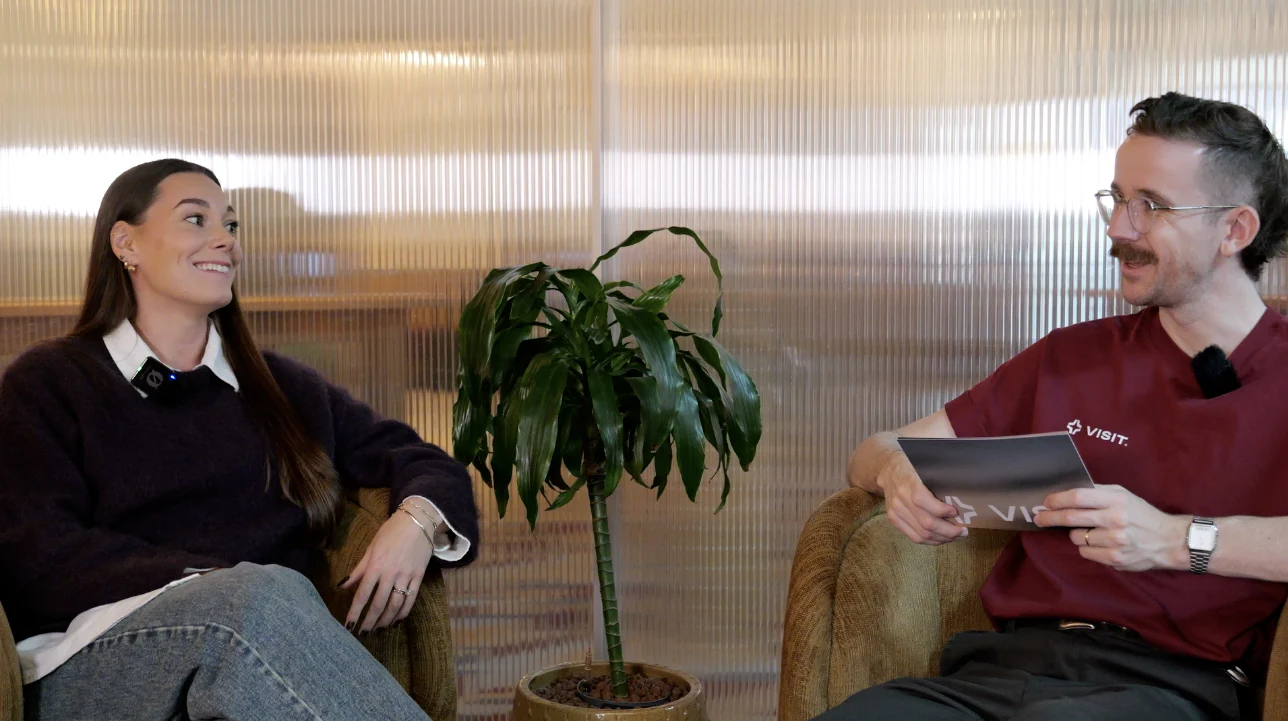
Declan: Andreas, welcome to the Fast Track, welcome to VISIT Summit — pleasure to have you here. Can you introduce yourself, tell us a bit about who you are, for those who might not know you?
Andreas: Sure. My name is Andreas Andersen, I’m the Group CEO of Liseberg. I’ve been working at Liseberg for 15 years, but I’ve been in the attractions industry for more than 25 — Tivoli in Copenhagen, and a global association of attractions called IAAPA. I’ve had different roles in the industry, but 25 years of working with visitor attractions.
Declan: That’s something you really love, then?
Andreas: I do, I do. It was actually a bit of a hobby that became my livelihood. I always loved travelling around visiting parks before I got a job at Tivoli.
Declan: So we’ll jump right into it. I read recently that some people have been saying that, in the attractions world, rides are no longer the thing that sets an attraction apart. Do you agree with that?
Andreas: I do. I think today there’s so much more than just building a carousel or a roller coaster. You have to create a totality of an experience that stretches out before and after the actual experience. There’s just so much you can do with a ride today — I mean, there is innovation, but it’s still the same basic tricks we use today as we did maybe 100 years ago. And therefore, I think the packaging, the totality, the branding becomes as important as the ride itself.
Declan: What would you say it is that sets Liseberg apart, then?
Andreas: Over the last 15 years, we’ve really been working very much on setting the stage for the attractions we build. It’s no longer enough to just buy a carousel and build it. You have to tell a story. You have to create an emotion. You have to put it into a context. And that’s what we do every time we do something new in the park — we reference back to our history, the setting, but also what kind of emotion we want the ride to create with the visitor.
Declan: And in reference to that, you’ve opened this new hotel — it’s been open about three years now — which has this very historic spin on it, referencing a lot of Gothenburg history. And now you’ve got the water park opening next year. So, two very new things. How do you grow an attraction without changing the thing people love about it — the old Liseberg that people love?
Andreas: It’s a balance. And you have to be a little bit courageous. The Liseberg brand, or the concept, is very elastic — it can take a lot of change without ruining it. I always tell an anecdote. Back when I worked at Tivoli many years ago, one of the complaints I got the year I started as COO was from a guest who complained about us moving a park bench. We moved a bench four metres, and that was apparently not a good thing, according to this guest. It illustrates that you have to be careful. There are some things that are holy cows, things you can’t touch — but at the same time, I also think you have to be able to keep challenging the concept, the brand, the emotions we try to create with what Liseberg is.
Declan: That’s really interesting. And one of the other things when you change things is that you modernise as well. Liseberg is continually modernising — you’ve got mobile tickets, which you’ve used for a good few years now, and I read about wristbands that’ll be pre-filled with a balance for guests to use. What do you think is a mistake that some attractions, or people in the industry, make when they try to modernise the guest experience?
Andreas: I think the overall objective must be that you facilitate, or ease, the guest journey. It has to be very simple. It has to elevate the experience, so you can focus on the experience — it shouldn’t take over the experience. A few years ago I went to Disneyland in California, and I wanted the full Disney experience. So I went online, booked my room, booked the tickets, everything. And I came to the park, and then I had to download an app, put my key on the phone, link my tickets to the app, and also book the attractions for the next day, blah blah blah. It was very stressful, and very complicated. I sometimes felt it would have been better if I had been an engineer. And I don’t think you want to create that experience — you really want to make it easy for the guest. As you mentioned, when we open the water park next year, we’re taking the digital journey to the next level, because you’ll have an RFID wristband you can use throughout your stay — to lock and open your locker, to pay with. So we’re trying to add these digital layers, but it has to be natural and easy for the guest.
Declan: Do you think there’s ever the chance that you have the guest who gets left behind in modernisation?
Andreas: Definitely. And we always try to have a non-digital option. For example, today all of our annual passes are digital, but if we have a guest who doesn’t have a mobile phone, we have to be able to provide a different option. So we’re always trying to take care of the guests who aren’t familiar with digital solutions.
Declan: One of the other things with modernisation — a hot topic that goes hand in hand with it — is sustainability. You modernise, and you also want to make it a more sustainable experience. I know Liseberg is at the forefront of sustainability — renewable energy in the park. I think you maybe had bees at one point, but not anymore.
Andreas: No, because they were a little too happy about the ice creams.
Declan: What do you think are some small, actionable steps businesses can take towards sustainability, if it’s something they’re not actively working with at the moment?
Andreas: It’s a good question. I think we all, in the industry, work within what you could call the sustainability paradox, in the sense that guests tell us it’s important, but they don’t act on it. So it’s not really a competitive advantage to a park like ours — I wouldn’t say anybody chooses us because we’re sustainable. But you could argue there’s a good risk that if we’re not sustainable, they could choose not to visit us. So for me, it’s a little bit of an insurance policy — apart from being a good citizen and feeling very strongly about the topic. I think it’s something we have to address, both as an industry and as a company, if we want to stay relevant. And in terms of actionable steps — anything you can do that’s guest-facing is obviously good, but a lot of the time sustainability is actually about everything that goes on behind the scenes. The impact of operating an attraction sustainably is very much about doing all the boring stuff, too. And we keep on doing that.
Declan: You spoke a little earlier about the yearly passes, for the people who keep coming back to Liseberg several times a year. How do you make a place like Liseberg somewhere people want to come back to, rather than somewhere they just tick off the list of theme parks to visit?
Andreas: I think we’re very much a regional park, with a regional audience, so we’re very focused on revisitation — creating new seasons, new events, new packages to get the second visit, or the third. It’s very much built into the way we manage the park. But obviously, at the end of the day, it’s all about giving people a good experience. If we don’t deliver, they won’t come back. And that’s a challenge for a volume product like ours, in the sense that we have days with four, five, six thousand guests in the park, and days with 35,000. Finding a way of delivering a good experience on a peak day — that’s the hardest challenge we have. But hopefully, here too, technology can help us in the future. We have some ideas.
Declan: A final question, then. When you’re on the park floor, what’s a moment that reminds you why you do this, and why it’s important to have places like Liseberg?
Andreas: I would say that if you work at Liseberg, you have to be a little bit of a circus horse. It’s something you either have or you don’t, something you like or you don’t. My background — I have a law degree, I’ve gone through the whole education system and had a career before working in the industry. But throughout my studies, I always worked in service roles. I worked at hotels and in restaurants, at Burger King, in shops. And I think that background gives me a really robust foundation today, because I actually really like service. I like interacting with people. I like the fact that you’re hosting other people. And I still have duty manager days at Liseberg, where I’m the person they call when something goes wrong. Those days — not because I’m good at it, but because it’s important for me to remind myself what it’s all about. And it is that experience, that moment, that guest we have in the park. It’s not just Excel sheets and standard operating procedures. It’s about the magic that happens when a family visits us and has the best day of the summer.
Declan: Awesome. That’s very cool. Thank you so much for joining us today, Andreas.
Andreas: You’re very welcome. Thanks.