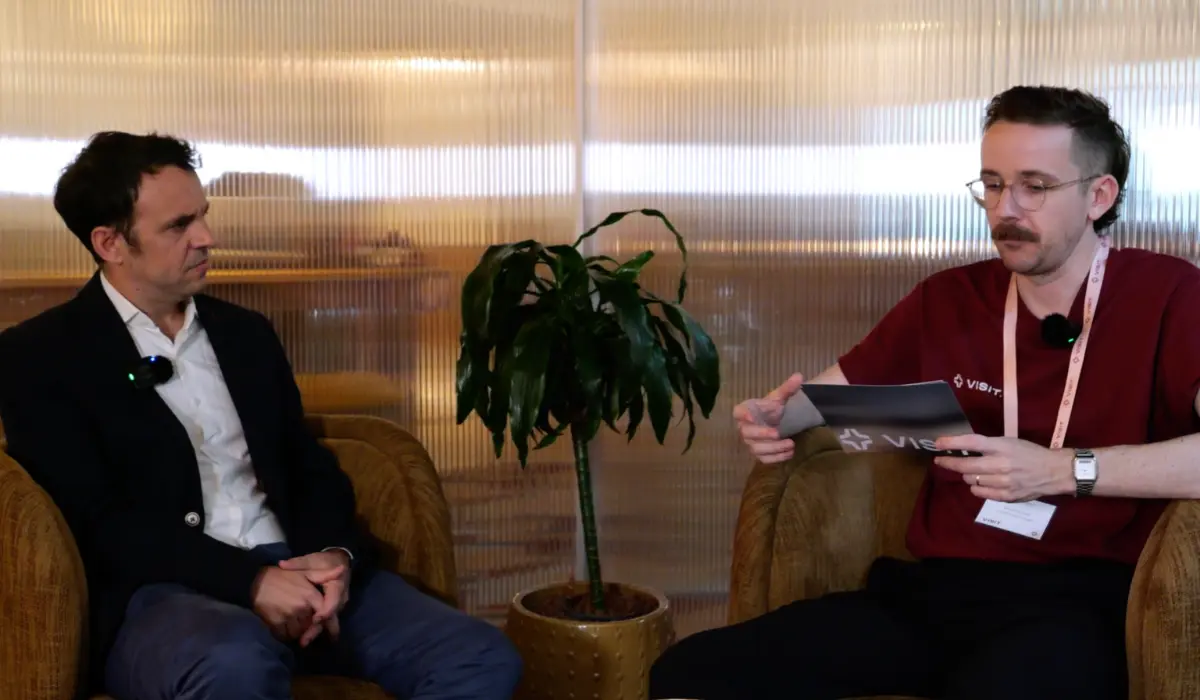
Declan: Welcome back to the Fast Track. Today I’m joined by Thibault from VISIT. Can you tell us a bit about yourself and what it is you do at VISIT?
Thibault: Thank you for having me — pleasure to be here. I’m currently the Head of AI. My background has always been on the technical side; I was a developer for many years. Recently AI kind of took over and became this big new thing, which is very interesting to look into. So I focus a lot on how we use AI at VISIT — both internally, to optimise our processes and work faster and better, and in what we can deliver to customers by adding AI to our products, so they can work smarter and faster operationally.
Declan: One of the big topics — and I feel like we’ve been talking about it for a long time now — is this whole thing with AI agents. One of the things we’re discussing is AI agents making bookings, making purchases. Do you really think people will let AI agents spend their money?
Thibault: Yes, I believe so. I like to bring it back to around the year 2000, when the internet came and a lot of skeptics said: this new thing, the internet, no one will trust it, no one will ever put their credit card number into this new website thing. It took a couple of years, but people started trusting it more and more. Tech also helped a lot — it came up with smart solutions like encryption, so that trust didn’t have to be something the human gives; it was enforced by technology. It’s going the same way with agents, except we’ve already learned from the internet. We’re already working on all those protocols and encryption methods, so we can trust the payments from agents, trace them, and so on.
I don’t think it will drastically change from day one. Especially for us in the travel industry, planning your trips is still something deeply personal — I think people really like to do that. Same with shopping; people like to browse and look at things. But for low-stakes things, where there’s no emotion to it — renewing a season pass, or booking a flight — in general you don’t pick a flight because it’s better than another; you book it because you need to go from A to B at a certain time, in a certain price range. For those, I think we’ll see AI agents pick up very quickly, because we’d love to automate the business trip too. You just need a hotel at a certain place and time, you have a budget — just pick whatever, fix that for me, I don’t need to care about it.
Declan: So maybe not people buying houses with AI agents, but the smaller purchases — the things that get made easier by AI agents.
Thibault: Exactly. The things that actually simplify your life, and don’t take the fun out of it either.
Declan: One big thing that’s come out recently is Muse, from Meta. For people who aren’t familiar with it, what’s the big deal?
Thibault: It’s an AI agent. It’s not revolutionary in any way. Where it’s important is that it’s from Meta — they already have a couple of billion users in their user base. So if they want to roll it out, they could be a prime candidate to really make it mainstream, and hopefully easy to use. It’s still really early — right now access is only in the US.
Declan: So what is it you can do with it?
Thibault: One of the main things they advertise is that you can book travel with it. I looked into that a bit deeper, and what it actually is: you can book a flight, because that’s the low-stakes kind of purchase. It’s able to talk to APIs and figure out a flight for you. You can just talk to it like it was your executive assistant — say “I need a flight on that date, based on this.” It can access your calendar too, so you could just say “I have a trip coming up next week for work, fix it.” But when it comes to booking a hotel, I think it’s just browsing the web — because, as we’ve discussed a lot over the last two days, the standards, protocols and APIs aren’t there yet. So think of it as your personal assistant, provided by Meta. Quite a bit of potential, I think, to reach a lot of consumers.
Declan: So let’s say we have Muse now, and that’s maybe the one that’s going to choose a hotel for me. Who owns the customer then? Who owns that booking — is it the agent, is it the hotel, is it split between them? How does that work?
Thibault: It’s not completely clear yet — it’s still being figured out. But in the end, the booking ends up in the booking system, so you’ll see who the booker is and you’ll own that booking part. But as we know, the agent isn’t going to browse your website anymore; it’s probably just going to talk directly to the booking engine, do the comparison, and so on. And at this stage there’s no real interest for the agent to identify itself — to say “I’m Declan’s agent and I’m looking for pricing.” So you’re probably going to lose the upper part of the funnel; what remains is the order. You’ll know the customer at the time they book, not before, when they do the research. So that part will be owned by the AI agents — for now, ChatGPT, or Meta, maybe.
Declan: Interesting. Would you say agentic commerce is going to kill SEO as we know it right now?
Thibault: No — it will kill SEO in the sense that you write pages for humans. Instead, you’ll write more and more content in a structured way, so it can be read by AI agents. The SEO work and goals will be slightly different, but it will remain, because we’ll want the agents to read that content and incorporate it into their training for new models. And once we have the protocols in place, AI agents will be able to access the website in real time and will need to read it. So you’ll focus on great content, structured with as much info as possible for AIs. And very importantly, they’ll love it if you have reviews — proof that what you wrote is real. When you say “this is the best experience in the city,” you’d better bring up some reviews next to it, so the AI agent trusts it and ranks it higher.
Declan: When you’re doing that discovery, is it hard for people watching this who think “my website’s written for humans” to even get started on this? Can anyone do it?
Thibault: Yeah. There are a couple of standards coming up, and places where you can put your website address and check whether agents are able to read it, if you follow some of the standards. I think our web team has added a session on that. There are quite a few competing standards, so right now you probably need to support ten different things, and we’ll see which one wins. But it’s not that much work, so it’s better to support all of them and be ready for all the AI agents, rather than not doing it.
Declan: Let’s say an AI agent is going to optimise — it’s going to look for the best price constantly, and keep driving the price down. Who survives in that race to the cheapest alternative?
Thibault: I’d say the more unique products, where you can’t really compete on price. Travel is still very unique — an experience is an experience. A ride in the amusement park in that city can’t really be compared with something else. So the more unique your product is, and the better reviewed it is, the more likely it’ll be recommended, and the more likely an agent will pick it — and maybe even recommend that the user pay slightly more for a better experience. It’s a completely different story in retail, where you can compare a t-shirt to a t-shirt; there, with these new capabilities, the agent will be able to scan an insane number of products to find the cheapest one. So, more unique products — and you need to work on your brand, so it’s known, recognised and trusted. Then it’ll be recommended, and price won’t really be a differentiator in that scenario.
Declan: One of the main things people worry about with AI agents is the fear of them making mistakes. Let’s say an agent makes a mistake and buys the wrong thing — I want a flight to New York and it gets me a flight to New Delhi instead. Who pays for that? Who’s responsible for the mistake?
Thibault: Right now it’s unclear — there’s no law or precedent that defines it. So we’re not sure, and there are a couple of different frameworks being developed to cover those cases. Because in your example, you prompted it, a company delivered the AI model, and a booking system accepted it — so there are three different parties that could be responsible to some extent. Right now we say each party has its own responsibility, and what we’ll need is for that to be traceable, so a human can go back and see where it failed in the chain. Was it an error here, there, or there? The only way we’re going to solve those disputes is by having a complete trace — being able to inspect it and say “this is where it went wrong, therefore this part of the chain is more responsible for the error.”
Especially on the payment side, there’s a lot of work being done right now so that agents have an ID and authentication — so we know it’s Declan’s agent, and not just a random agent on the internet making a purchase we can’t trace. On the payment side, we’d be able to follow the entire trace: searching, getting a price, actually using it, everything. So there’s a lot of work in that domain to make sure everything is traceable, so we can pinpoint where things go wrong. And I’m sure the European Union, for example, will come up with regulations that define each part of the chain’s responsibilities clearly.
Declan: How far off are we from sitting here next year, and both you and I have booked our hotel, our travel and everything with an AI agent? Can we do it by next year?
Thibault: For a business trip, I’d guess so, yes — in one way or another. I’m quite sure you’d have to accept or validate it, because we’re in Europe, so an agent can’t transact without you manually approving. But it might be that you just click the OK button.
Declan: Are you excited to get started on that kind of thing?
Thibault: I’m excited to have an AI agent that takes care of the boring stuff for me. Definitely.
Declan: (laughs) That’s a really nice way to end it. Thank you so much for joining us.
Thibault: Thank you, Declan. Thank you.